Pierre Paulin (1927 - 2009)
Pierre Paulin (1927-2009) was one of the leading figures of French design in the second half of the twentieth century. Although his organically shaped, brightly coloured armchairs became emblematic of the 1960s, his much broader body of work reflects a continuous exploration of comfort, the human body and the organization of interior space.
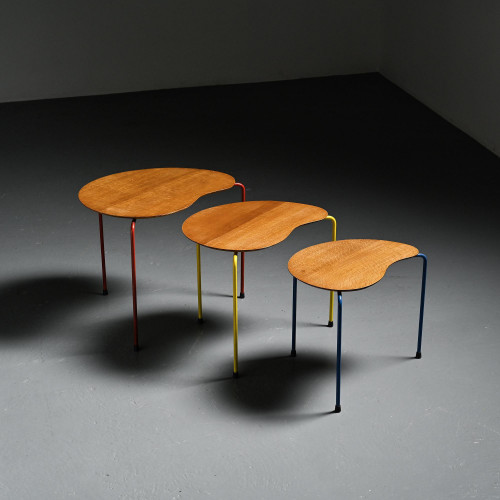
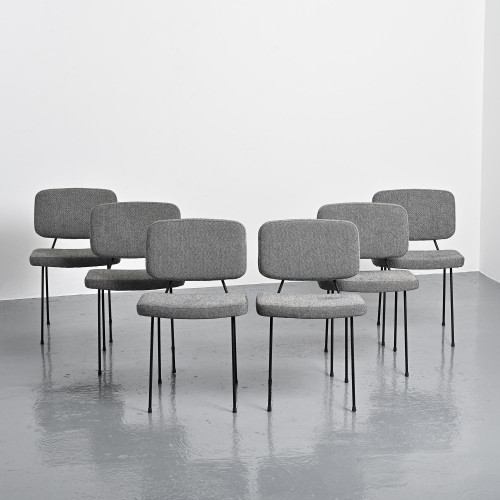
Born into a family of artists and inventors, Paulin initially intended to become a sculptor. A hand injury interrupted this ambition and led him towards furniture design. He studied at the Centre d'art et de techniques, later known as the École Camondo, before beginning his career in the circle of Marcel Gascoin. Living on rue de Seine in Saint-Germain-des-Prés, the young Paulin regularly visited the American and Scandinavian furniture shops that were beginning to establish themselves in the neighbourhood. These discoveries helped shape his interest in simple, functional and accessible furniture, far removed from the spectacular designs with which his name would later become associated.
In 1953, he presented furniture for an "ideal apartment" at the Salon des arts ménagers, some of which was subsequently produced by Meubles TV. He then collaborated with Thonet France, developing lightweight seating and furniture, before beginning a long collaboration with the Dutch manufacturer Artifort in 1959.
This partnership marked a decisive turning point. Paulin explored the possibilities of metal structures, synthetic foams and stretch fabrics. Upholstery was no longer simply a covering: stretched over a frame, it defined the very shape of the chair, dissolving the traditional distinctions between backrest, seat
and armrests. The Mushroom (1960), Ribbon (1966) and Tongue (1967) chairs exemplify this search for a new relationship between furniture and the human body.
Behind their apparent playfulness, these creations reveal considerable structural rigour. Paulin was not simply interested in producing spectacular silhouettes: he sought to imagine new ways of sitting, relaxing and inhabiting space. This exploration gradually led him beyond individual objects towards complete interior landscapes, in which seating, carpets and architectural volumes formed a unified environment.
From 1969 onwards, Paulin worked with the Mobilier national and, in the early 1970s, designed several rooms in the private apartments of the Élysée Palace for Georges and Claude Pompidou. These interiors combined integrated furniture, enveloping forms and contemporary materials, marking a deliberate departure from the palace's traditional decoration. François Mitterrand also commissioned Paulin to design his presidential office in the 1980s.
For many years, Paulin was celebrated primarily for his creations of the 1960s rather than for the full extent of his career. The major retrospective held at the Centre Pompidou in 2016 brought renewed attention to the diversity of his work, particularly his early designs, experimental projects and interior environments.
Pierre Paulin's work cannot therefore be reduced to Pop furniture or prestigious public commissions. From the rational designs of the 1950s to the flexible and modular environments of the following decades, his work reflects a consistent ambition: to free furniture from established conventions and adapt it to the gestures, postures and changing patterns of everyday life.